
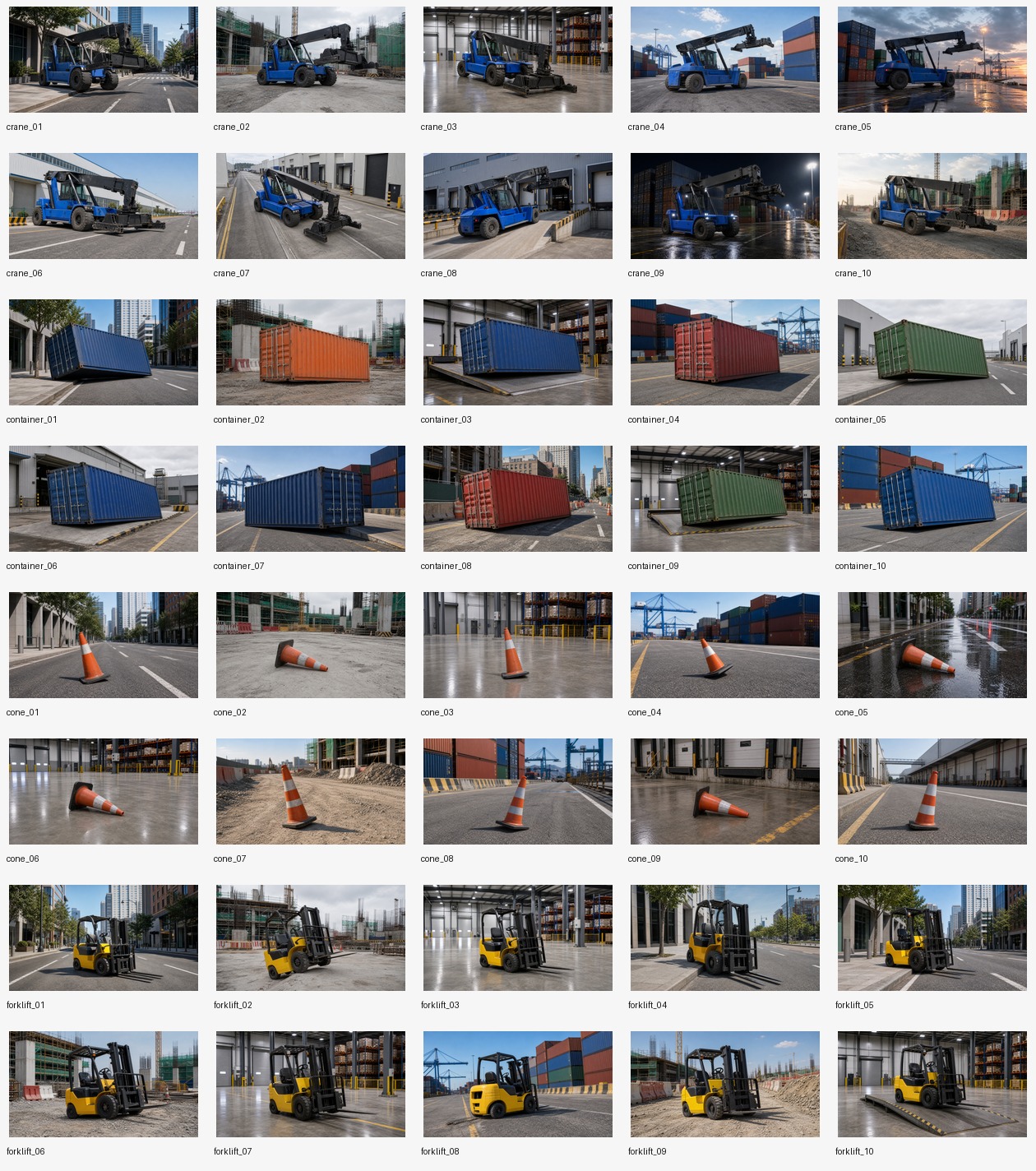
Case Facts
- Project type
- Synthetic vision sample generation for gantry, yard, construction and work-vehicle recognition demonstrations.
- Input scope
- Usable scenes and target classes were selected from authorized materials. Public pages do not expose original archive names, temporary paths or internal file sources.
- Scene simulation
- 48 simulation images at 1280 by 720 were prepared across clear day, night yard, rain camera, fog or haze, sunset backlight, motion blur, foreground occlusion and surveillance compression conditions.
- AI synthetic samples
- The final set contains forklift, crane, container and cone classes, 10 samples per class and 40 samples in total, with metadata.csv recording IDs and source relationships.
- Pose variants
- Additional finished samples show foreground tilt and orientation changes in city road, construction site and factory backgrounds.
- Delivery boundary
- The samples support solution preview and sample-expansion assessment. Formal training and release acceptance still require authorization checks, manual annotation review, real-scene validation and metric evaluation.
Project Background
The customer needed to preview synthetic visual samples related to gantry equipment, yard scenes and work vehicles before defining the recognition task, capture scope and model validation route. The work focused on reviewable visual samples and delivery materials, not on promising model performance.
Material Screening and Scene Organization
The processing stage removed low-relevance ordinary road samples and then generated 48 scene simulation images around port yards, construction sites, warehouse environments and surveillance-camera characteristics. The quality record covered sample counts, scene distribution, brightness range, duplicate candidates and abnormal external-source checks.
Four-Class AI Synthetic Samples
Samples were organized into forklift, crane, container and cone classes, with 10 images in each class. The set shows target appearance, pose, background and lighting variation so the business side can discuss annotation rules, capture requirements and sample structure before model training.
Foreground Pose Variants
To explain orientation changes of foreground targets in different backgrounds, finished samples were added for city-road, construction-site and factory scenes. This material is for visual communication and is not a conclusion about real-site distribution or model generalization.
Customer Review Materials
The delivery also included Word/PDF review documents and contact-sheet previews, making it easier to inspect sample structure, scene coverage and follow-up capture requirements. Public pages only show screened preview information and do not expose internal source paths or unconfirmed authorization materials.
Applicable Scenarios and Boundaries
This delivery pattern fits early solution presentation, sample-expansion assessment, capture-plan discussion and annotation-rule confirmation for vision projects. Training or formal acceptance requires source authorization, duplicate checks, annotation review, train/validation/test splitting, real-site regression and task-metric evaluation.